
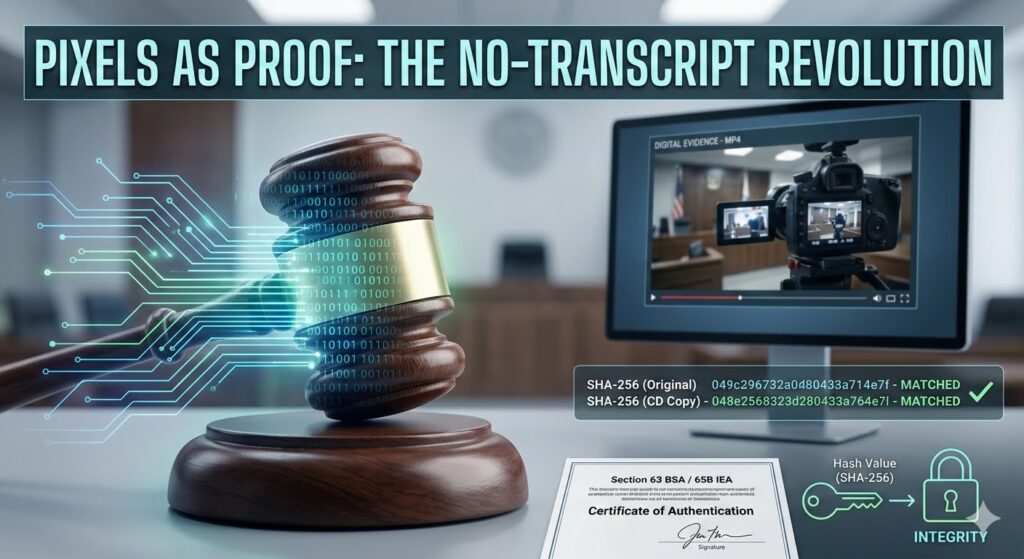
In my 17 years as a software engineer, I learned that a hash value doesn’t lie. If a file’s integrity is verified, you run it. You don’t ask for a printed version of the binary code to “understand” it. But as I finish my 6th semester of law, I’ve realised the courtroom doesn’t always work at the speed of light. For years, we’ve been stuck in a loop where digital video was treated like a second-class citizen that needed a “paper passport” (a transcript) to enter the record.
The recent case of Kailash v. State of Maharashtra (2025) has finally pushed a much-needed “system update” to this logic.
1. The Raw Data: A Raiding Party in Akola
The facts are simple: A police raid in a small hut in Akola led to the recovery of 39 kg of Ganja. But the police did something smart; they brought a professional photographer, Santosh Solanke. He didn’t just take photos; he video-recorded the entire search, the witnesses, and the weighing of the contraband on a Sony HD Camera.
In my IT days, we’d call this a “Live Capture.” In court, this video, stored on a CD, became the central nervous system of the case.
2. The Protocol: The Digital Handshake
To get this “data” into the legal “database,” the police followed the right protocol. The photographer issued a Section 65B Certificate (the predecessor to our current Section 63 BSA).
As a techno-legal professional, I see this certificate as the “Checksum” of the legal world. It’s the digital handshake that tells the Judge: “The pixels you see on this CD are a bit-for-bit match of what the camera sensor saw in that hut.” The Trial Court hit ‘Play’, saw the accused at the scene, and convicted him. It was a clear, high-definition win for justice.
3. The High Court’s “System Error”
However, the Bombay High Court (Nagpur Bench) crashed the proceedings. They threw out the conviction and ordered a re-trial for a reason that, to a techie, sounds like a legacy bug: “The lack of a written transcript”.
The High Court was worried about Section 278 of the CrPC (now Section 310 of the BNSS). This rule requires that a witness’s evidence be “reduced to writing” and read back to them. The Court feared that if there wasn’t a text-based narration of the video, the record was incomplete. They were essentially demanding a paper “log file” for a video stream that was already perfectly clear.
4. The Supreme Court “Patch”
On September 15, 2025, the Supreme Court (Justices Manoj Misra and Ujjal Bhuyan) stepped in to fix the code. Their ruling was a masterclass in common sense:
- A CD is a Document: Under Section 3 of the Evidence Act, a video isn’t just a “visual aid”; it is a Document.
- No Transcript Needed: If you have a valid Section 63 BSA / 65B IEA certificate, the video is admissible as-is. You don’t need to “translate” pixels into paper.
- Judicial Economy: The SC noted that if the High Court was confused, they should have simply hit “Play” themselves under Section 391 CrPC (BNSS), rather than wasting years on a re-trial.
My Take
The Human-Centric Patch: As I prepare for the AIBE, this case resonates with me deeply. We cannot expect 2026 justice to run on 19th-century paper trails. This judgment is a win for Judicial Economy. It tells us that the law is finally trusting the integrity of the “Bit.”
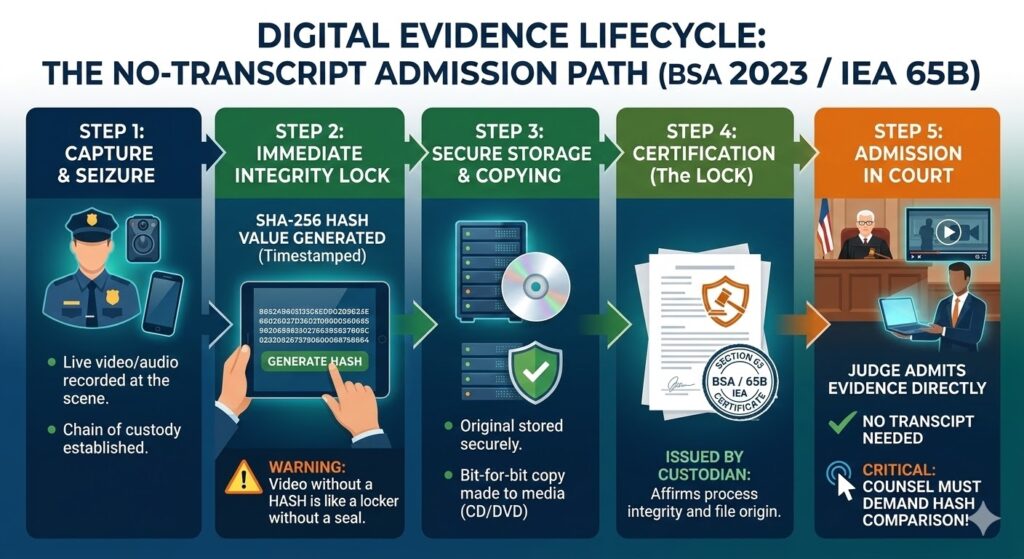
The Critical Warning: “The Certificate is the Lock, but the Hash is the Key.” Under Section 63 of the BSA (2023), the law now expects more than just a signature. If a lawyer today doesn’t demand a Hash Value (SHA-256) comparison, they are failing their client. A video without a Hash is like a locker without a seal; it’s “Admissible,” but its Integrity is a question mark.
The Industry Verdict: For my colleagues in both Law and IT, here is your takeaway:
- Integrity is King: Your Section 63 BSA certificate is your “Root Access.” If that certificate is solid, your video stands on its own.
- Don’t wait for the Trial: Generate your Hash Values at the time of seizure. It’s the only way to prove the video hasn’t been “edited.”
- Direct Interaction: We must encourage Judges to interact with digital evidence directly. Justice today is served by a Judge’s Gavel, but it’s powered by a precise, verifiable digital record.
The analysis provided on QickStep: Bits & Bylaws is for informational and educational purposes only. While this content integrates 17+ years of System-Level IT expertise with ongoing LLB (Semester 6) academic insights, it does not constitute legal advice or a lawyer-client relationship. Guideline Compliance: This analysis is drafted with reference to the Bharatiya Sakshya Adhiniyam (BSA) and BNSS frameworks. Jurisdiction: All content is subject to the jurisdiction of the courts in Lucknow, UP, India. Verification: Readers are advised to verify digital forensic standards and specific case precedents before placing reliance for judicial proceedings.